
A Content Operations Primer
Content Operations may sound like a buzzword — but for anyone who’s ever struggled to turn creative ambition into consistent output, it’s the missing link.
After years of leading content teams and studios across media, brands, and international organizations, I’ve learned that great content doesn’t scale by accident.
It needs systems: thoughtful, flexible, and human-centered.
This primer is a compact guide to what Content Operations are — and why they matter just as much to a three-person editorial team as to a global publisher.
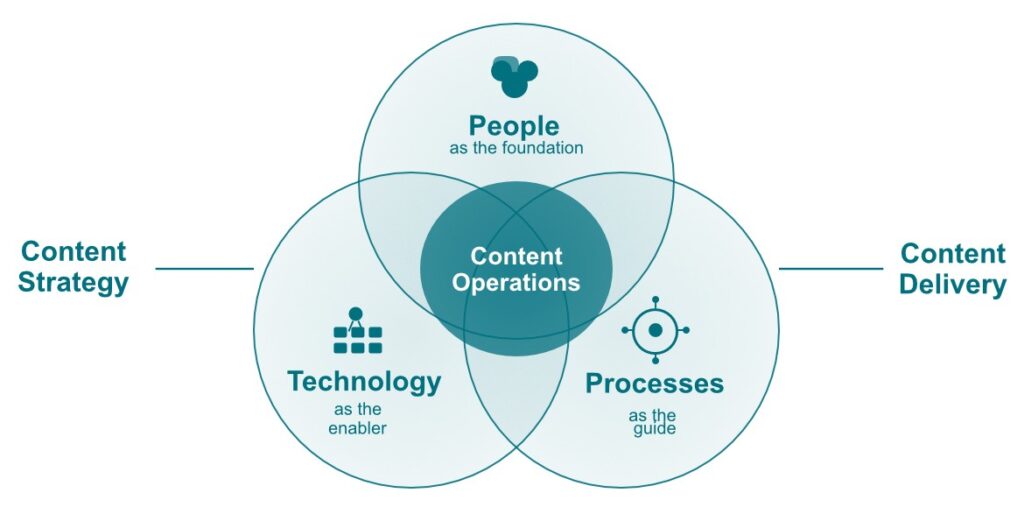
1. What Content Operations Really Mean
At its core, Content Operations orchestrate people, processes, and platforms to plan, produce, manage, and deliver content efficiently, coherently, and at scale.
Most organizations do content. Few manage it as a system — and that’s where performance, efficiency, and creative impact are won or lost. Think of it as the operating system behind storytelling — invisible when it works, painfully visible when it doesn’t.
2. Why It Matters
Infinite content, finite attention: your talent, ideas, and domain knowledge aren’t enough. You need structure.
The paradox. Teams produce more content, faster—yet audience trust and engagement are flatlining. Why? Because content is often reactive, fragmented, or disconnected from strategy and audience understanding. When you’re trapped in a hamster wheel, how do you find time to strategise? You’re just delivering.
AI seems to solve many problems, but alone it can create even bigger ones. AI can accelerate production, but it also amplifies inefficiency when processes are weak. Without solid operational foundations, teams simply create bad content faster.
Content Ops brings order to the chaos. Content Ops helps teams: ➔ Enable collaboration at scale—from in-house teams to freelancers and external agencies. Everyone shares the same picture, knows what’s happening and why, and stays in sync. ➔ Move from reactive to proactive—planning content strategically rather than chasing daily urgencies. ➔ Align on business goals—connecting storytelling to measurable business outcomes.
3. The Building Blocks of Content Ops
Content Operations sits at the crossroads of editorial craft, technology, and organizational design. It’s not a new department—it’s a cross-functional framework that connects teams, tools, and workflows into a cohesive system.
1. People: roles and mindset.
Content Ops is a team sport. Writers, designers, analysts, developers, and marketers all need shared systems—and shared accountability. It’s not about hierarchy, but about alignment: who owns what, how information flows, and how decisions get made. ➔ Think newsroom meets product team — agile, cross-functional, and data-informed.
2. Processes: from chaos to flow.
Strong processes transform creativity into rhythm. They define how content moves from idea to delivery—how it’s approved, repurposed, and measured. Without them, teams become reactive, trapped in urgent mode. With them, you create space for strategy, testing, and creativity. ➔ The goal isn’t bureaucracy — it’s velocity with control.
3. Platforms: the ecosystem that connects it all.
A future-fit content stack is modular, not monolithic.
Composable systems—CMS, DAM, workflow, analytics—let you evolve as tools and needs change. 👎 Choosing technology based on price or convenience leads to lock-in and frustration. 👍 Choosing it for scalability, interoperability, and flexibility enables sustainable growth. ➔ The real cost isn’t financial — it’s conceptual: how future-proof is your architecture?
4. The Invisible Scaffold of Content Excellence
Most organisations see content as output: articles, posts, videos, pages. But content—any type of content—is a means to an outcome: helping people make sense of the world they live in (the original job of news media); helping business people make decisions (B2B publishers and information services); sparking joy (entertainment); developing healthy, sustainable brand relationships (brand publishing).
The infrastructure that makes those outputs sustainable—the invisible scaffold behind creative excellence—is what moves you from outputs to outcomes: content that performs, engages, and is produced with both speed and quality.
From reactive to strategic. Without Content Ops, teams chase deadlines and publish reactively—responding to trends or requests instead of steering the story.
With a solid operational backbone—shared calendars, workflows, metadata, and analytics—content creation becomes intentional. It’s guided by insights, aligned with goals, and delivered through repeatable, scalable systems.
Structure doesn’t kill creativity — it enables it. This is hard for many creators to accept. But when roles, tools, and timelines are clear, creative energy flows where it matters most: ideas, storytelling, and design. And because processes handle the noise — approvals, governance, quality assurance — teams can focus on producing content that’s both distinctive and consistent.
Organizations that invest in Content Ops gain more than efficiency. They build resilience—the ability to adapt to new platforms, AI disruption, and shifting audience behaviour without losing coherence. They don’t react to change; they anticipate it.
5. Not just for the big players
It’s easy to think Content Operations is for large corporations with armies of editors and fancy systems. It’s not. Small teams need it just as much — maybe more.
Every team already has operations. The question is whether they work for you or against you. Even modest systems — a shared calendar, naming conventions, transparent workflows — can radically improve how content is planned and delivered.
👍 And when it comes to tools, the future belongs to those who stay composable 👎 “Turnkey” platforms may look efficient, but they age fast and lock you in.
Composable systems — where tools talk to each other and evolve (see: connectors, APIs..) — let you stay agile, scalable, and ready for what’s next.
The real investment isn’t money, but mindset. Designing a system that grows with you — that’s what separates constant firefighting from sustainable creative flow.
6. The Takeaway
Content Operations isn’t a luxury—it’s the backbone of modern storytelling. Whether you’re a global brand, a small team, or a solo creator, the challenge is the same: clarity. Knowing why you create, how you create, and for whom. AI may change how we create, but not why.
Content still needs purpose, process, and people—the real “operating system” behind every great story.
Operational chaos, shabby processes, and obsolete tools demotivate people. A well-functioning system, by contrast, provides security and room for creative confidence.
Looking to relocate to Vienna. Open to senior conversations — Director and VP level — in media, publishing, and corporate brand communications. 📧 berlin@valentinagiannella.eu
Substack
Beyond Berlin
Stories big and small that start in Berlin and look eastward, where the heart of the continent beats and its future is shaped. beyondberlin.substack.com ↗
Berlino⬄Europa
Storie grandi e piccole che iniziano a Berlino e guardano verso est, dove batte il cuore dell’Europa e si scrive il suo futuro berlinoeuropa.substack.com ↗
Publications
Tedesco ma non troppo
Una lingua e dieci motivi per amarla. Con Valentina Giuliani · Edizioni ETS, 2026
Scheda editore ↗
Podcast ↗
Campione della memoria
Memoria storica in Germania: come è nata e dove sta andando l’Erinnerungskultur Info e download ↗
Info
Proud, passionate citizen of one Europe: one that goes from Lisbon to Luhansk, from Tromsø to Tbilisi.
🇪🇺 🇮🇹 🇩🇪 🇦🇹 🇺🇦 🇬🇪